2025-12-22 0 Comments

When traditional pharmacies close, and an urgent need for medication arises late at night, a 24-hour uninterrupted pharmacy vending machine is more than just a service extension; it is a health beacon that can generate continuous value. For B2B enterprises, chain pharmacies, and medical service institutions aspiring to explore blue ocean markets, operating a successful pharmacy vending machine is far from a simple device deployment. It is a systematic project integrating precise site selection, technological compliance, and data-driven operation.

Foundation: Precise Site Selection and Compliance First

Successful operation begins with a precise location. “Pain-point scenarios” based on demand are the primary choice. A pharmacy vending machine project set up on a university campus in the United States validates the immense potential of closed or semi-closed, high-traffic areas with clear nighttime needs, such as university campuses, large industrial parks, transportation hubs, and large residential communities. For example, the smart medicine vending machine introduced by the Fengtai Campus of Minzu University of China directly serves over ten thousand students and staff, meeting students’ immediate medication needs at night or after class, and has received high praise.

While determining the location, compliance is the first hurdle that must be crossed. In China, many local drug regulatory authorities have issued specialized management regulations. For instance, Beijing and Qingyuan County in Zhejiang Province have both formulated management specifications for setting up automated medicine vending machines. These clarify that the setting entity must be a legal drug retail enterprise and specify requirements for drug storage, remote pharmaceutical services, etc. This means that partnering with a compliant pharmacy or chain brand holding a “Drug Operating License” is a prerequisite for legally launching the project. The implementation of projects in Fengtai and Shunyi Districts was completed under the guidance of the local Market Supervision Bureaus, ensuring the model’s compliance and sustainability.

Core: Intelligent Technology and Supply Chain Support

The core competitiveness of modern pharmacy vending machines lies in the intelligent management system and powerful supply chain behind them. Mere “automated vending” can no longer meet demands; the true value lies in the remote empowerment of a “smart pharmacy.”

  1. Smart Inventory and Precise Restocking: The backend systems of leading companies’ medicine vending machines are integrated with central smart pharmacy systems, enabling real-time monitoring of inventory, sales data, and temperature/humidity conditions for each device. For example, the smart pharmaceutical vending machines provided by partners like IMT also feature warning functions that can automatically lock drugs nearing expiration, ensuring medication safety.
  2. Automated Fulfillment and Efficient Dispensing: To handle potential online orders (e.g., O2O delivery), large-scale self-service medicine vending machines integrate efficient automated sorting systems. The first self-service medicine (pickup) machine unveiled in Beijing’s Haidian District, enhanced by AI large models, can complete 120 automatic sorting and packaging operations per hour, with a storage capacity of up to 15,000 boxes and a dispensing accuracy rate of 100%.
  3. Remote Pharmaceutical Services: A key link for compliance and professionalism. All successful case devices are equipped with 7×24-hour remote pharmacist consultation service channels. Users can obtain medication guidance by scanning a QR code or making a phone call. This compensates for the lack of on-site staff and forms a complete service loop.

Advancement: Data-Driven Operation and Business Model Innovation

Once the device operates stably, the operation enters the stage of data-driven analysis and model innovation. By analyzing sales data, product categories can be optimized (e.g., focusing on antipyretics/analgesics and gastrointestinal medications in campus settings, or chronic disease medications in community settings), enabling precise marketing.

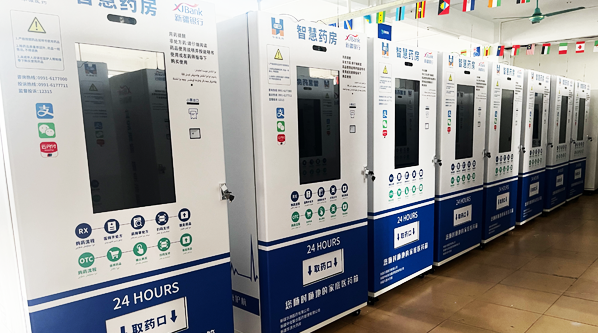
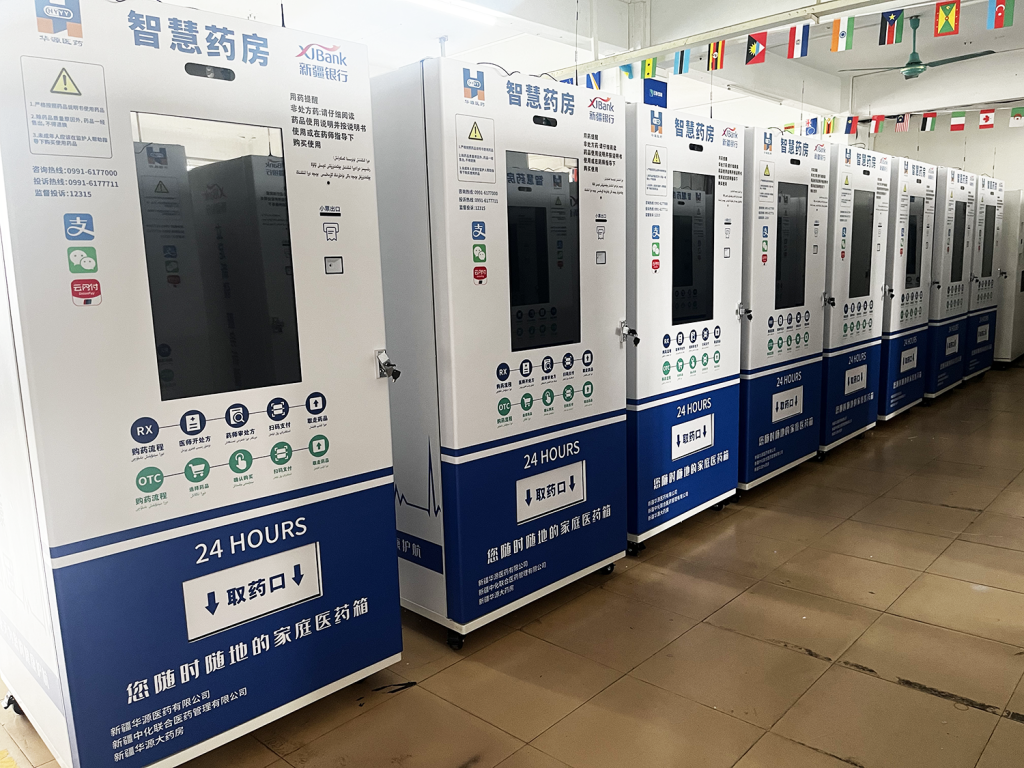
More forward-looking innovations are emerging. For instance, the Parcyl project in Singapore demonstrated the potential of automated prescription drug dispensing machines. Using two-factor authentication and computer vision technology, they ensure prescription drugs are accurately and safely dispensed to patients, reducing medication pickup time by approximately 90%. Furthermore, the “24-Hour Smart Medicine Cabinet” showcased in Xinjiang integrates robotic arms and contactless medical insurance settlement functions, collaborating with “doctor-pharmacy-patient” data platforms to explore deeper business models like prescription outflow and insurance payment.

Case Insights: From Single-Point Validation to Scale Replication

Looking at domestic and international cases, a clear path to success is evident:

  • University Case: The project expanded from 2 devices to 8, optimizing for campus community needs (especially sexual and reproductive health products) and increasing usage rates through word-of-mouth, demonstrating the importance of continuous evaluation and iteration.
  • Tech-Pharmacy Enterprise Cases: Show how technology-driven pharmacy companies use smart medicine vending machines as encryption points for their offline networks, deploying from campuses and communities to transportation hubs, with the ultimate goal of building a health service network covering the user’s “last meter.”
  • Industry Trend: Intelligent upgrades bring significant benefits. Taking a smart unmanned pharmacy in Shanghai as an example, after its transformation, labor costs were saved by over 50%, checkout efficiency increased by 3 to 5 times, and inventory accuracy reached 99.9%. This proves the immense commercial value of automation in cost reduction and efficiency enhancement.

Conclusion

Operating a successful pharmacy vending machine essentially involves deploying a miniature, fully automated, 24/7 smart pharmacy at the forefront of demand. It requires operators to possess the professional compliance of pharmaceutical retail, the systematic operational capabilities of a technology company, and a mindset for refined user service. For B2B decision-makers, this is not merely about adding a sales channel; it is a crucial step towards embracing the digital future of pharmaceutical retail and seizing a strategic position in the 24/7 health economy.

Leave a Comment

Your email address will not be published.