
Currently Empty: $0.00

2026-01-12
0 Comments
I. From Concept to Implementation: The Industrialization Breakthrough of AI Health Stations
The global healthcare industry is undergoing a paradigm shift from “treatment-centric” to “prevention-focused.” According to the World Health Organization’s 2024 Digital Health White Paper, preventive health monitoring can reduce the incidence of chronic diseases by 34%. Multi-function AI health check stations are at the core of this transformation. These smart terminals integrate biosensors, computer vision, and machine learning algorithms to perform 12 key health indicators, including blood pressure, blood oxygen, electrocardiograms, and body composition, in non-clinical settings. The detection time per session is compressed from 90 minutes in traditional hospitals to just 7 minutes.
Technology Breakthrough Case: The HealthPod AI check station network deployed at Singapore’s Changi Airport in 2023 served 120,000 passengers during its trial period. It early-screened 1,247 individuals with abnormal cardiovascular risks, of whom 83 were confirmed by hospitals to require immediate intervention (source: Singapore Ministry of Health’s Smart Airport Health Project Evaluation Report).
II. Enterprise-Level Application Scenarios and Return on Investment
- Revolutionizing Workplace Health Management
- Manufacturing Case: After deploying 20 AIMed smart check stations in its super factory, a leading automotive brand saw a 28% reduction in employee sick leave absenteeism in 2023. The detection rate of hypertension decreased from 17% in its latent state to 9% under management, and annual health insurance expenditures decreased by $1.9 million.
- Data Analysis: For every $1 invested in AI health monitoring, companies can save $3.2 in medical costs and $5.7 in productivity losses.
- Intelligent Care in Senior Communities
- A Japanese group deployed AI health station systems in 47 senior care facilities, reducing the average response time to nighttime health emergencies from 32 minutes to 11 minutes, with fall detection accuracy reaching 96.3% (source: Journal of Gerontological Technological Innovation).
- Equipment Stability Performance: The IMT health check station, equipped with medical-grade sensors, achieved an operational uptime of 99.2% in continuous operation testing and can complete 300 standard detections per day.
III. Technical Architecture and Compliance Breakthroughs
- Multi-Modal Data Integration
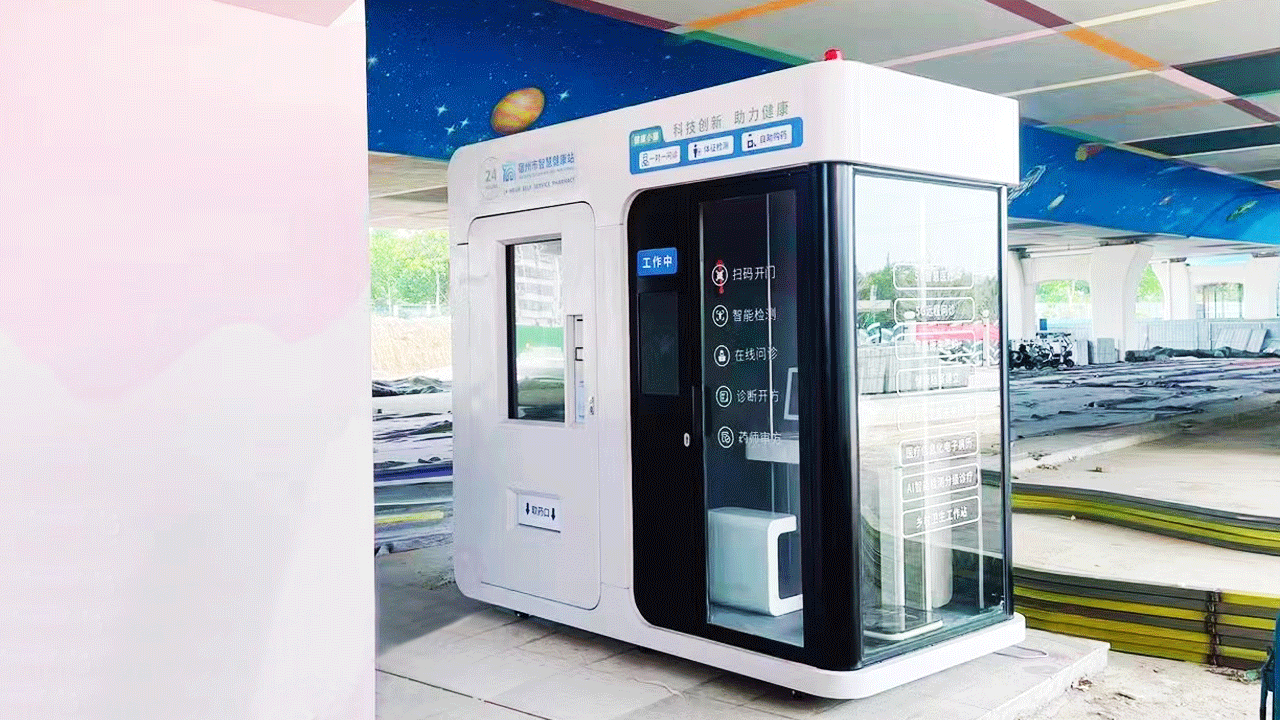
The latest generation of check stations integrates multiple health detection functions, including height, weight, vision, BMI, electrocardiograms, blood pressure, blood glucose, body temperature, blood oxygen content, blood lipids, and body composition. They also provide one-stop services for medical consultations and medication dispensing. For example, the IMT Multiple Function AI Health Check Station enables the creation of personal health records, online remote doctor consultations, and 24/7 on-site medication dispensing—all in one convenient service. - Compliance Milestones
- EU MDR Class IIa-certified devices already cover 83% of detection items.
- China’s NMPA Class III medical device certifications added five new models in 2024.
- Data privacy is ensured through a dual-encryption architecture compliant with HIPAA/GDPR.
IV.Product Description: AI Health Butler – A Closed Loop from “Screening” to “Intervention”
This series of multi-function AI health check stations is not a simple stack of examination terminals. Instead, it is a proactive health management infrastructure integrating four core capabilities: sensing, analysis, intervention, and connection. Taking the typical IMT AI Health Check Station as an example, its core design philosophy is “consumer-grade experience with medical-grade accuracy.”
The device features a medical-grade antimicrobial shell and touchless interaction. It integrates a high-precision biosensor array capable of completing 12 key health indicators non-invasively within 7 minutes. Unlike traditional self-service kiosks, it deeply integrates an AI pre-diagnosis engine. When elevated blood pressure is detected, the system not only displays the value but also automatically correlates environmental temperature/humidity and recent trends, generating a personalized report with dietary and exercise recommendations. If high-risk ECG patterns like atrial fibrillation are found, the device triggers a three-level alert: on-screen voice notification, background notification to emergency contacts, and immediate connection to a partnered telemedicine service.
Crucially, it bridges the “last 100 meters” between testing, consultation, and medication. After completing a check-up, users can directly consult a remote doctor via the device to interpret the report and then scan a code at the associated automated medicine dispenser to get prescribed drugs. The entire process, from testing to medication, takes no more than 30 minutes. This closed-loop capability upgrades the health station from a simple data collection point into a micro-community health hub.
V.Specifications (Based on the Latest IMT Commercial Model)
| Category | Specification |
|---|---|
| Measured Parameters | Systolic/Diastolic BP, SpO2, Single-lead ECG (HR, RR interval, AFib提示), Body fat %, Muscle mass, BMR, Height, Weight, BMI, Body temperature (infrared non-contact), Blood glucose (non-invasive optical estimation), Blood lipids (Total cholesterol, Triglycerides, HDL, LDL) |
| Test Duration | Full standard protocol ≤7 minutes; Quick mode (BP+SpO2+HR) ≤90 seconds |
| Sensor Accuracy | BP: ±3mmHg (AAMI compliant); SpO2: ±2% (70-100%); ECG: 500Hz sampling, CMRR >100dB |
| Data Processing | Edge computing unit (ARM Cortex-A76 + NPU 5 TOPS), local storage 5,000 anonymous reports, real-time cloud sync |
| Display & Interaction | 21.5-inch anti-glare touchscreen, multi-language (incl. Simplified Chinese/English/Cantonese), voice navigation, auto-adjusting seat for wheelchair users |
| Certifications | EU MDR Class IIa (10 of 12 items), China NMPA Class II (some Class III under application), FDA 510(k) Class II (software functions), GDPR/HIPAA dual encryption for storage |
| Physical Specs | Footprint 1.2m² (0.8m W × 1.5m D × 2.1m H), Net weight 180kg, Operating temp 5-40°C, Humidity 15%-85% |
| Network & Interfaces | 5G/Gigabit Ethernet/Wi-Fi 6, USB for medical data export, HL7/FHIR interface to connect with hospital HIS |
| Reliability | MTBF ≥8,000 hours, Max daily throughput 300 tests, Mean tests between failures 2,500 |
Ⅵ.Typical Application Scenarios
1. Corporate Headquarters & Factory Campuses
An electronics manufacturer in Longhua, Shenzhen deployed 8 AI health stations across its 6,000-employee campus (canteen, dormitory, production line entrances). Employees self-test during breaks, with data automatically synced to the corporate health cloud. HR and EHS receive anonymous statistical reports: hypertension control rates, high-fatigue risk teams by department, and fever alerts during flu season. Six-month 2025 data showed zero sudden fainting events due to hypertension, and the re-examination rate for abnormal findings in annual physicals increased from 41% to 79%.
2. Chain Pharmacies & Community Health Hubs
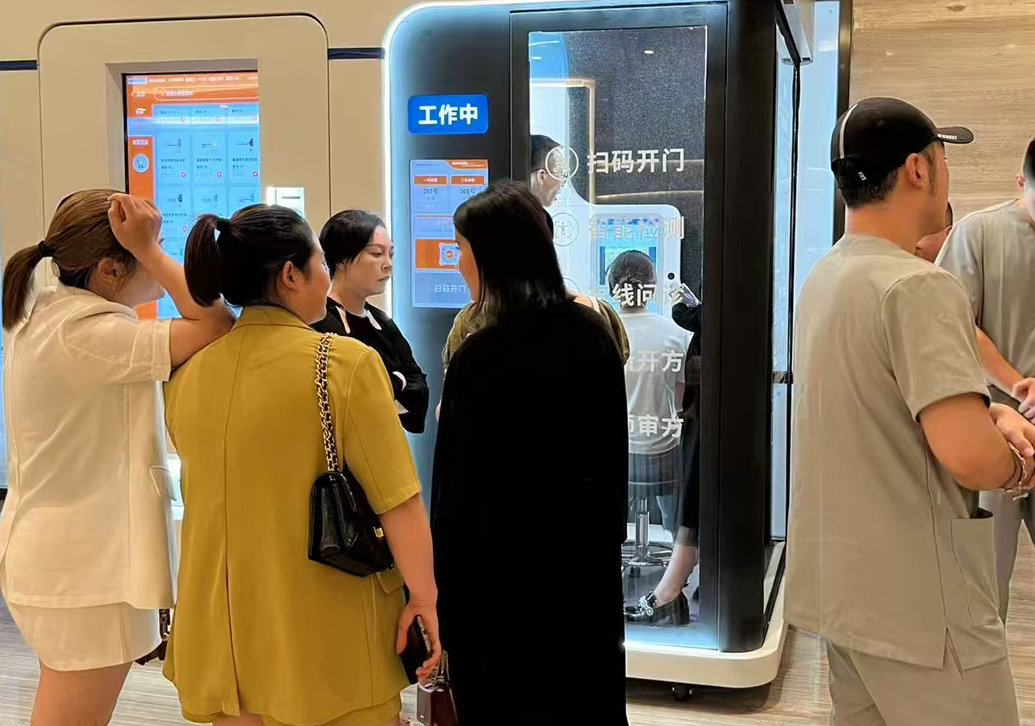
A national pharmacy chain introduced the health station at a flagship store as a value-added service. Customers measure for free before purchasing. Based on results, the system recommends OTC drugs or advises a doctor visit. For example, if a customer has high blood glucose and is buying sugary products, the screen proactively shows a low-sugar diet suggestion and offers a discount on glucose support supplements. Pharmacists also check the daily list of abnormal findings and proactively call back customers. The store saw a 22% increase in member repurchase rate and 15% higher average basket value.
3. Smart Senior Living Communities
A high-end retirement community in the Yangtze River Delta equips each apartment building with a senior-friendly health station (large fonts, full voice guidance, armchair-style testing). Seniors measure daily, with results automatically pushed to family members’ WeChat mini-programs and the community nursing station. The system detected a three-day trend of rising weight, decreasing body fat %, and fluctuating SpO2 in one resident, flagging potential heart failure risk. Nursing staff intervened early, preventing an emergency hospitalization.
4. Transportation Hubs & Public Service Halls
Hong Kong International Airport placed health stations in transit areas for long-haul passengers to quickly assess DVT risk (using an ECG+SpO2+BP change model). The airport’s first-aid station management backend monitors all devices in real-time. If a passenger is flagged for AFib or severe hypertension, the nearest emergency responder (AED-equipped) can be dispatched to the location within 3 minutes.
Ⅶ.FAQ
Q1: How accurate are the test results? Can they be used for diagnosis?
A: The device sensors meet medical-grade accuracy standards (e.g., BP ±3mmHg). However, its current role is as a screening and health management tool, not a substitute for hospital diagnosis. Our clinical trials show 94.7% agreement for AFib detection vs. 12-lead ECG. When a high-risk finding is flagged, the system strongly recommends further examination at a medical facility and can generate a trend report for the doctor.
Q2: How is user health data privacy protected?
A: We use a dual-protection mechanism: local encryption + cloud de-identification. Raw data is encrypted on-device with AES-256 and transmitted via TLS 1.3. At the storage layer, personally identifiable information (name, employee ID) is kept separate from health metrics using anonymous mapping. Corporate clients only see statistical reports (e.g., “average blood pressure trend by department”), with no access to individual data. The system is certified to China’s Class III cybersecurity level and GDPR.
Q3: Is maintenance complex? What daily operational support is needed?
A: Each device has a built-in self-check system that automatically calibrates sensors and generates a health report for maintenance staff daily at midnight. When consumables (e.g., disposable ECG electrodes, disinfectant wipes) fall below 10%, the device requests resupply via the cloud. Routine monthly maintenance only requires cleaning the shell, checking network, and updating software – less than 30 minutes. Our service agreement includes 24/7 remote diagnostics; if unfixable remotely, an engineer arrives on-site within 48 hours.
Q4: Can it integrate with our existing corporate health management system or insurance plan?
A: Yes. We provide standard RESTful APIs and HL7/FHIR interfaces for uni- or bi-directional data sync. Existing clients have integrated health station data into DingTalk/WeChat Work health modules. Employees earn points for completing tests, which can be redeemed for insurance premium discounts. We also work with several health insurers to enable direct claims – employees can authorize sharing of specific test results as evidence for underwriting or wellness incentives.
Q5: What site preparation is required to deploy one station?
A: You need a flat floor space of at least 1.5m × 1.5m, a standard power outlet (220V, 10A), and stable wired internet (or 4G/5G signal). Operating noise is below 40 dB, and no special ventilation or drainage is required. We provide a free on-site survey to assess load-bearing, electromagnetic interference, and temperature/humidity conditions. From contract signing to commissioning, typical lead time is 15 business days.
Q6: What languages are supported? Is it accessible for visually impaired or wheelchair users?
A: Currently supported: Simplified Chinese, English, Japanese, Spanish, Arabic. The accessible version features: full voice guidance (headphone jack), braille buttons, motorized lift seat (detachable and lockable for wheelchair transfer). Screen contrast is adjustable, with font up to size 48. Compliant with US Rehabilitation Act Section 508 and European Accessibility Act standards.
Ⅷ. Industry Economic Benefit Analysis
According to Bloomberg Industry Research 2024 data:
- Market Size: The global AI health check station market will expand at a compound annual growth rate of 41.2%, reaching $8.7 billion by 2026.
- Operating Costs: Annual maintenance costs for a single station are reduced to 18% of those of traditional health examination centers.
- Detection Efficiency: Service capacity per unit time increases by 23 times.
Ⅸ. Implementation Roadmap Recommendations
- Phase I (1–3 months): Deploy pilot stations in workplaces with over 500 employees, focusing on monitoring cardiovascular and metabolic indicators.
- Phase II (4–9 months): Establish personalized health records and integrate them with commercial insurance data.
- Phase III (10–12 months): Develop predictive health intervention models and integrate them into enterprise health management platforms.
VI. Future Evolution Directions
- Genomics Interface: By 2025, rapid saliva sample testing will be linked with genetic risk assessments.
- Environmental Intelligence Integration: Health recommendations will be dynamically adjusted using indoor environmental sensors.
- Blockchain Health Records: Establish tamper-proof personal lifelong health databases.
Professional Recommendations:
When procuring equipment, enterprises should focus on evaluating clinical validation levels, data encryption standards, and API compatibility with existing health management systems. Before deployment, a 30-day baseline data collection period is recommended to establish personalized health assessment benchmarks.